Week 2
Reading
Extra Reading (PhD Level)
- Answer set programming at a glance — Brewka et al.
Slides
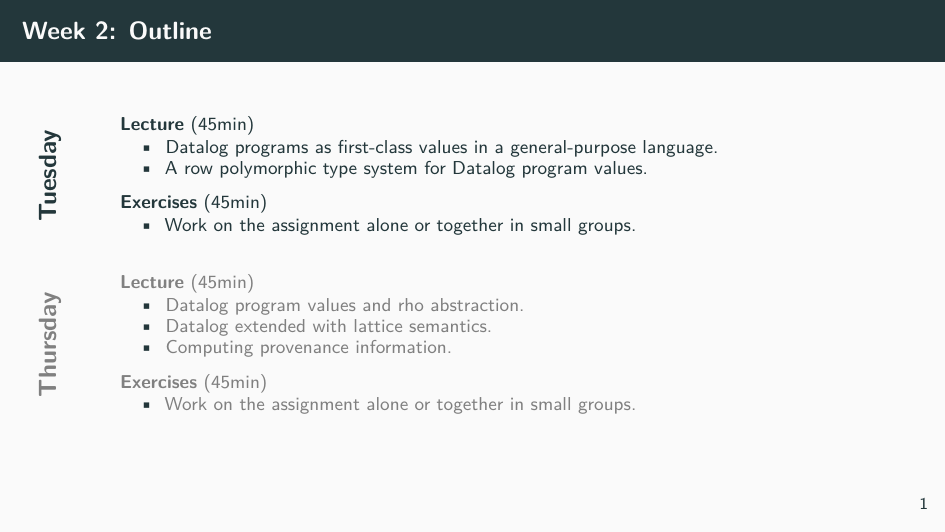
Exercises
Exercise 02.01: Rewrite the following SQL query:
SELECT
    C.CustomerName, O.OrderDate, P.ProductName
FROM
    Customers C
JOIN
    Orders O ON C.CustomerID = O.CustomerID
JOIN
    Products P ON O.OrderID = P.OrderID
WHERE
    P.ProductPrice > 10;
as a Flix function that uses Datalog.
- The function should use
injectandquery. - The function should take the relevant tables as lists of tuples.
- The function should return a list of tuples.
Exercise 02.02: Rewrite the following SQL query as a Flix function:
SELECT
    S.StudentName,
    C.CourseName,
    MAX(G.Grade) AS HighestGrade
FROM
    Students S
JOIN
    Grades G ON S.StudentID = G.StudentID
JOIN
    Courses C ON G.CourseID = C.CourseID
GROUP BY
    S.StudentID, S.StudentName, C.CourseName
ORDER BY
    S.StudentName;
- Define a data type
Gradewhich is one of:-3, 00, 02, 4, 7, 10, 12. - Introduce a lattice on
Gradewith-3as the smallest element.
Exercise 02.03: The Bacon number of an actor or actress is the number of degrees of separation they have from the actor Kevin Bacon. Per Wikipedia:
- Kevin Bacon himself has a Bacon number of
0. - Actors who have worked directly with Kevin Bacon have a Bacon number of
1. - If the lowest Bacon number of any actor with whom X has appeared in any movie
is N, X’s Bacon number is
N + 1.
Assume we have a relation StarsWith(Actor, Actor):
- Write a Flix function to compute the Bacon number of every actor.
Exercise 02.04: Given the Flix expressions:
let p1 = #{ A(x, y) :- B(x, x), C(y). };
let p2 = #{ C(x) :- F(x, y), G(y, x). };
- What are the row types of
p1andp2?
Exercise 02.05: Implement Ullman’s Algorithm with a Flix function that has the signature:
def ullman(g: List[(String, Bool, String)]): Map[String, Int32]
where g is the precedence graph represented as a list of edges and where the
Boolean indicates whether an edge is positive (true) or negative (false).
The function should return a map from each predicate symbol (String) to its
stratum. If the precedence graph cannot be stratified, the returned map should
map every predicate symbol to -1.
Ullman’s Algorithm can be used to determine if a Datalog program is stratified, and if so, to compute the stratum of each predicate symbol. The algorithm can be described as follows:
- If there is a positive edge
A <- B, then the stratum ofAmust be at least the stratum ofB. - If there is a negative edge
A <- not B, then the stratum ofAmust be at least the stratum ofBplus one. - If we ever encounter a stratum number higher than the number of predicate symbols in the program, then the program cannot be stratified.
Hint: Use lattice semantics.
Exercise 02.06: Rewrite the following SQL query as a Flix function:
SELECT
    E.EmployeeName,
    D.DepartmentName,
    S.Amount AS LatestSalary,
    S.DateReceived
FROM
    Employees E
JOIN
    Salaries S ON E.EmployeeID = S.EmployeeID
JOIN
    Departments D ON S.DepartmentID = D.DepartmentID
WHERE
    S.DateReceived = (
        SELECT MAX(S2.DateReceived)
        FROM Salaries S2
        WHERE E.EmployeeID = S2.EmployeeID AND S2.DepartmentID = D.DepartmentID
    );
Hint: Use lattice semantics.
Hint: Use fix to find the most recent salary per employee.
Hint: You will need more than one relation/lattice.
Exercise 02.07: Consider the Datalog program:
    Edge(1, 2). Edge(2, 4). Edge(1, 3). Edge(3, 5). Edge(5, 4).
R1: Path(x, y) :- Edge(x, y).
R2: Path(x, z) :- Path(x, y), Edge(y, z).
- Draw two distinct provenance trees for the fact
Path(1, 4). Label each internal node with the rule (R1orR2) used to derive it, and mark the EDB facts. - For each of your two trees, write down the provenance path w.r.t.
{Edge}. - Flix guarantees that
pquerycomputes a provenance tree of minimal height. Which of your two trees canpquery pr select Path(1, 4) with {Edge}return?
Exercise 02.08: You are a financial crime investigator tracing laundered money. Money moves between accounts in three ways:
Wire("acme-holdings", "Cayman National Bank", "shellcorp-7", 100)states that money was wired from accountacme-holdingsto accountshellcorp-7through the bankCayman National Bankat time100.Cash("alpine-invest", "offshore-trust-x", 550)states that cash was handed over fromalpine-investtooffshore-trust-xat time550.Crypto("shellcorp-7", "Binance", "shellcorp-12", 250)states that money was swapped fromshellcorp-7toshellcorp-12on the crypto exchangeBinanceat time250.
The last component of each fact is a timestamp (a Unix-style integer). You are given the following transaction log:
Wire("acme-holdings", "Cayman National Bank", "shellcorp-7", 100).
Wire("shellcorp-7", "Banco General", "tropical-imports", 110).
Cash("tropical-imports", "shellcorp-7", 120).
Wire("nordic-ventures", "LGT Bank", "offshore-trust-x", 150).
Wire("pelican-trading", "Banco General", "shellcorp-12", 210).
Crypto("shellcorp-7", "Binance", "shellcorp-12", 250).
Wire("acme-holdings", "Danske Bank", "nordic-ventures", 300).
Crypto("shellcorp-12", "Kraken", "riviera-estates", 320).
Wire("nordic-ventures", "Danske Bank", "acme-holdings", 350).
Wire("riviera-estates", "HSBC", "luxe-yachts", 380).
Wire("shellcorp-12", "Julius Baer", "alpine-invest", 400).
Cash("alpine-invest", "offshore-trust-x", 550).
Write a Flix function:
def followTheMoney(src: String, dst: String): Vector[String]
which documents how money flowed from account src to account dst, as a
vector of human-readable strings, e.g.
"acme-holdings wired money to shellcorp-7 via Cayman National Bank",
"tropical-imports handed cash to shellcorp-7", or
"shellcorp-7 swapped crypto to shellcorp-12 on Binance".
Your evidence must hold up in court: the transfers must form an unbroken chain
from src to dst, and money cannot leave an account before it has arrived,
i.e., the timestamps along the chain must be strictly increasing.
Test your function by tracing the money from acme-holdings to
offshore-trust-x.
Hint: Use pquery.
Exercise 02.09: You are given a database of currency exchange rates, where
a fact Rate("DKK", "EUR", 0.134) states that 1 DKK buys 0.134 EUR:
Rate("DKK", "EUR", 0.134).
Rate("DKK", "SEK", 1.55).
Rate("SEK", "NOK", 0.98).
Rate("EUR", "USD", 1.08).
Rate("EUR", "GBP", 0.85).
Rate("GBP", "USD", 1.27).
Rate("USD", "JPY", 155.0).
Rate("USD", "CHF", 0.88).
Rate("CHF", "EUR", 1.06).
Rate("KRW", "USD", 0.00072).
Write a Flix function:
def convert(amount: Float64, src: String, dst: String): Option[Float64]
which converts amount from currency src to currency dst, possibly through
a chain of intermediate currencies, or returns None if no conversion chain
exists. The effective rate of a conversion chain is the product of the rates
along it.
Test your function by converting 1,000 DKK to USD and 1,000 DKK to KRW.
Hint: Use pquery.
(Hard, Optional): There are two ways to convert DKK to USD (via EUR, or via EUR and GBP) with slightly effective rates. Which one does your function compute? How could you change the Datalog program such that the provenance path is guaranteed to be the chain with the best effective rate?
Exercise 02.10: Given the Flix function signature:
def reachable(g: Set[(Int32, Int32)], src: Int32, dst: Int32): Bool
which takes a graph, represented as a set of edges, and returns true if there
is a path from src to dst in the graph, write three implementations:
- An implementation that uses first-class Datalog constraints.
- An implementation that uses functional programming.
- An implementation that uses imperative programming.
You must test your functions on a non-trivial graph that contains cycles.
Hint: You will need to use recursion.
Hint: You may want to use MutSet or MutMap for the imperative version.
Exercise 02.11: Reflect on Exercise 02.10:
- Which implementation was the fastest to write?
- Which implementation do you find the most elegant?
- How would you extend the functional and imperative versions with parallelism?
Exercise 02.12: Benchmark Exercise 02.10:
- Write a simple benchmark to compare the performance of the three implementations.